
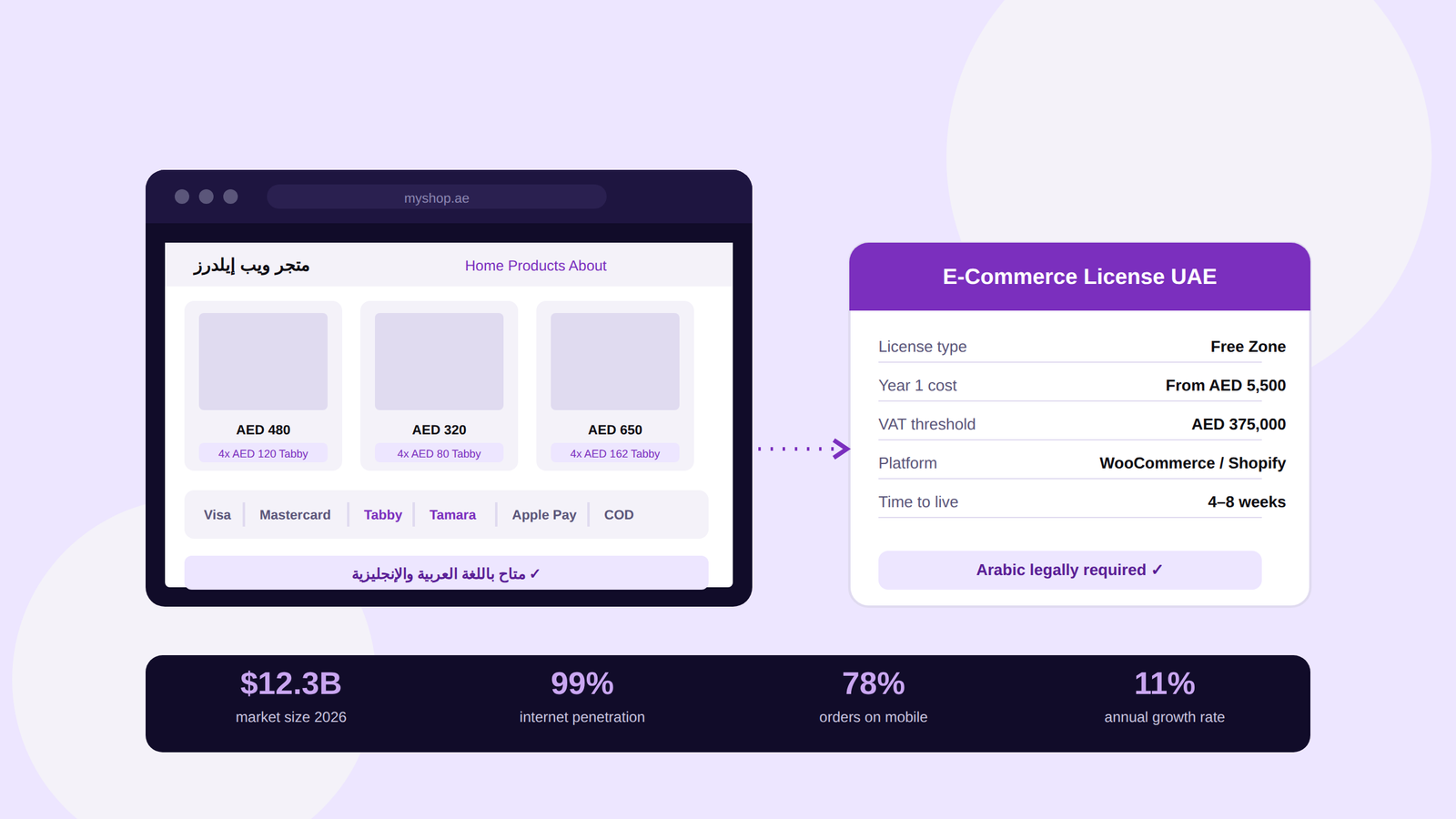
The UAE has one of the highest internet and smartphone penetration rates in the world, a fast-growing online shopping habit, and a government actively pushing digital trade. It is also one of the more regulated markets to sell into: you need a real license before your first sale, Arabic isn’t optional, and “free zone” doesn’t automatically mean you can sell to anyone you want. This guide walks through what actually has to happen, in order, to get a compliant, working online shop live in the UAE in 2026.
The short version
- You need an e-commerce license before you sell anything online — including through Instagram or WhatsApp.
- Free zone licenses are cheaper and faster, but can’t sell directly to UAE mainland consumers without a dual license.
- Arabic is a legal requirement under UAE Consumer Protection Law, not just good SEO practice.
- Shopify launches faster; WooCommerce costs less long-term and gives more control over Arabic SEO.
- Telr and PayTabs are the standard starting gateways for UAE SMEs; add Tabby or Tamara for BNPL.
- Realistic timeline from license application to a live, payment-ready store is 4–8 weeks, not the “live in a day” some ads promise.
Step 1: Choose Your Business Structure
Every legitimate online shop UAE business starts here, and it’s the decision most founders get wrong by optimizing for price instead of fit. The two routes are a free zone license or a mainland license, and they are not interchangeable.
Free Zone
100% foreign ownership, lower setup cost, fast digital processing. Best if most of your customers are outside the UAE or you sell through marketplaces like Amazon.ae or Noon.
Mainland
Issued by the Department of Economic Development. Costs more upfront, but lets you sell directly to UAE consumers without a dual license or distributor.
The trap most founders fall into: picking a free zone license because it’s cheaper, then discovering they can’t legally sell directly to UAE mainland customers without a dual license or local distributor — an extra AED 15,000–30,000+ per year they didn’t budget for.
If your inventory sits in the UAE, your customers are UAE consumers, and you plan to ship cash-on-delivery orders around Dubai or Abu Dhabi, you are functionally running a mainland retail business — regardless of which license looked cheaper on a comparison page.
| Factor | Free Zone | Mainland |
|---|---|---|
| Foreign ownership | 100% | 100% (since 2021 reform) |
| Sell directly to UAE mainland | Needs dual license | Yes |
| Typical Year-1 cost | AED 5,500–15,000 | AED 15,000–25,000+ |
| Office requirement | Virtual/flexi-desk options | Physical office (Ejari) usually required |
| Setup time | 2–5 working days | 1–3 weeks |
| Best for | Cross-border sellers, marketplaces, digital products | UAE-focused retail, B2B, government tenders |
Step 2: Get Your Online Shop UAE License
Whichever structure you choose, the license itself follows the same broad shape: pick your activity wording (it must match what you actually sell), reserve a trade name, submit ID documents, pay the fees, and receive your license and establishment documents.
Decide your exact activity: physical goods (general trading/retail), digital products and services, or a marketplace model. The wording on your license has to match how you invoice and fulfill orders, or your bank and payment gateway approvals will stall later.
Pick your jurisdiction. For free zone, popular e-commerce-friendly options include IFZA, Meydan, SHAMS, and RAKEZ for lean operations, or Dubai CommerCity and Dubai South if you need physical fulfillment infrastructure. For mainland, apply through your emirate’s Department of Economic Development (DED).
Reserve your trade name and submit passport copies and application forms for all shareholders.
Pay the license fee and receive your trade license and establishment card.
Open a corporate bank account. This step alone often takes longer than the license itself — UAE banks run thorough KYC checks, and free zone addresses sometimes trigger extra compliance questions.
Step 3: Get the Legal Basics Right
This is the part most generic “start an online store” guides skip, and it’s the part that actually carries financial and legal risk in the UAE.
Arabic is a legal requirement, not an SEO nice-to-have. Article 26 of UAE Federal Law No. 15 of 2020 requires that consumer-facing data, advertising, and contracts be available in Arabic alongside any other language. That covers your terms of service, privacy policy, and product information — not just your homepage. Non-compliance carries real penalties, including fines.
- Get the right license activity. Selling physical goods under a consulting or marketing license is a common, costly mismatch that surfaces during bank or gateway approval.
- Publish terms and a privacy policy in Arabic and English. Required under the Consumer Protection Law and the e-commerce law, and it applies even to a personal Instagram shop.
- Register for VAT once you cross AED 375,000 in taxable turnover — register with the Federal Tax Authority over any 12-month period (voluntary from AED 187,500).
- Install an SSL certificate and write a clear returns policy. Both are baseline requirements under the e-commerce and consumer protection laws, not optional extras.
Step 4: Choose Your Platform
Shopify and WooCommerce both work well in the UAE, support AED currency, and connect to the local payment gateways — the right choice depends on what you’re optimizing for, not which one is “better.”
| Factor | Shopify | WooCommerce |
|---|---|---|
| Time to launch | Days | 1–3 weeks (professional build) |
| Monthly cost | $29–299+ | Hosting from ~AED 200/month, no platform fee |
| Arabic RTL support | Via apps | Native, more control |
| SEO control | Good | Stronger — full URL and content control |
| Maintenance | Fully managed | Self-managed (updates, security) |
| Best for | Fast launch, low technical overhead | SEO-driven, content-heavy, highly custom stores |
If you want to be live in days with minimal technical involvement, Shopify is the practical choice. If you’re building for long-term organic search growth, need deep Arabic-English bilingual control, or want to avoid recurring app fees as you scale, WooCommerce is usually the stronger long-term investment — which is the platform most of our own UAE builds are on.
Step 5: Set Up Payments
Shopify Payments isn’t available in the UAE, so both platforms route through a third-party gateway either way. UAE banks also run aggressive 3D Secure fraud checks, which means an international gateway without strong local bank relationships can silently fail a meaningful share of UAE-issued card transactions — a problem that often doesn’t show up until you’re already live.
| Gateway | Typical fee | Best for |
|---|---|---|
| Telr | ~2.5–2.9% + AED 0.50 | UAE-focused SMEs, fastest local approval |
| PayTabs | ~2.85–2.9% + AED 1 | New stores, GCC-wide reach (Mada support) |
| Stripe | ~2.9% + AED 1 (local) | Tech-classified businesses, SaaS, subscriptions |
| Amazon Payment Services | ~2.8–3% + AED 1 | Established, higher-volume retailers |
Stripe does not support Mada (the UAE/GCC local debit scheme) — route Saudi and some UAE debit traffic through a Mada-capable gateway if that matters to your customer base.
Step 6: Localize for UAE Shoppers
- Build Arabic in from day one, as a native right-to-left experience, not a translation plugin layered over an English theme.
- Optimize for mobile first. Roughly 78% of UAE online orders happen on a phone — a slow or awkward mobile checkout is the single biggest silent revenue leak.
- Offer Apple Pay. Adoption is high among UAE shoppers, and one-tap checkout measurably lifts mobile conversion.
- Plan delivery with a UAE-aware courier such as Aramex or a local fulfillment partner — same-day and next-day delivery are now the norm in Dubai and Abu Dhabi, and shoppers compare on this.
Want a WooCommerce store built UAE-compliant from day one — Arabic, payments, and licensing-aligned activity wording included?
Chat with WebElders on WhatsAppRealistic Timeline
Plenty of free zone ads promise a “license in 60 minutes.” That’s true for the license document itself — it is not true for having a working, payment-ready store.
Frequently Asked Questions
Do I need a license to sell online in the UAE?
Yes. Federal Decree-Law No. 14 of 2023 covers any sale made through a website, app, or social media account, including Instagram shops and WhatsApp Business. You need either a free zone e-commerce license or a mainland trade license with an e-commerce activity before you legally process a single sale.
Should I choose a free zone or mainland license for my online shop?
Free zone licenses are cheaper and faster, with 100% foreign ownership, but cannot sell directly to UAE mainland consumers without an additional dual license or local distributor. Mainland licenses cost more upfront but let you trade with local customers without that restriction. If your customers are mostly outside the UAE, free zone is usually the better fit; if most of your sales are to UAE residents, mainland avoids a costly workaround later.
Is Arabic required on a UAE online shop?
Yes, by law. Article 26 of the UAE Consumer Protection Law requires that data, advertising, and contracts related to the consumer be provided in Arabic, alongside any other language. This covers your terms of service, privacy policy, and product information, not just marketing copy. Non-compliance carries penalties that can include fines.
How much does it cost to start an online shop in the UAE?
A free zone e-commerce license starts around AED 5,500 to 8,000 in year one. A mainland license typically runs AED 15,000 to 25,000 once visas and office requirements are included. On top of the license, budget for a platform (Shopify from $29/month, or WooCommerce hosting from roughly AED 200/month), a payment gateway, and a developer if you want a custom build.
Do I need to register for VAT?
VAT registration is mandatory once your taxable turnover exceeds AED 375,000 in a 12-month period. Voluntary registration is available from AED 187,500. Most online shops in their first year fall below the mandatory threshold but should still track revenue closely, since registration has to happen promptly once you cross it.
Should I use Shopify or WooCommerce for a UAE online shop?
Shopify is faster to launch and fully managed, which suits sellers who want to go live in days with minimal technical work. WooCommerce costs less long-term, gives full control over Arabic right-to-left layout and SEO, and avoids ongoing app fees, which suits sellers planning a content-driven or highly customized store. Neither is objectively better; the right choice depends on technical comfort and growth plans.
Do I need to offer Buy Now Pay Later (BNPL) like Tabby or Tamara?
It’s not legally required, but it’s close to expected by UAE shoppers in 2026. Tabby and Tamara together account for a meaningful share of UAE checkout volume, and stores that add BNPL for orders over roughly AED 200 often see a noticeable lift in average order value.
Where to Go From Here
Licensing, legal compliance, platform, payments, and localization — get these five right and the rest of running a UAE online shop is operations, not guesswork. The pieces below go deeper on cost breakdowns, platform migration, and growth once you’re live.
Skip the trial and error — get the license, platform, and payment setup right the first time.
Get it set up on WhatsAppNeed your online shop sorted?
We build, fix and manage online shops — same-day response. Message us on WhatsApp and tell us what you need.
Message us on WhatsApp